What Does 2B Lead Mean? The Pencil Hardness Scale, Explained
Everybody knows the number stamped on a school pencil's barrel, and almost nobody knows what it counts. A 2B is a rung on a ladder that runs from pale, scratchy 9H to soft, black 9B — the H-to-B pencil hardness scale the drafting world works in, and the one the American number pencil quietly maps onto. When a bubble-sheet exam demands a No. 2, it's asking for roughly a B-grade core: dark enough for the scanner to register, hard enough that your palm doesn't reprint the answer grid. So what does 2B lead mean, and which grade belongs on your desk? Here's the whole ladder.
What a "lead" actually is: graphite, clay, kiln
Start with the oldest wrong word in the trade: there is no lead in a pencil core — not the metal, not the toxic one. Sixteenth-century English miners who dug up native graphite called it "black lead" because it marked like metal on a tally stick, and the name never died. A core is powdered graphite blended with clay, extruded into rods, fired, then soaked with wax.
The mix is the entire story. Graphite marks; clay binds. A rod with little clay shears off generously, glides across the page and sits dark. Push the clay up and the core hardens, deposits less per stroke, and lies lighter and grayer. That one dial, run to both extremes, is the whole 9B-through-9H scale. Grade isn't a coating or a brand trick; it's a recipe — and it behaves the same whether it's sharpened into wood or sold as a 2mm refill rod.
The full pencil hardness scale, 9H to 9B
The letters come from the European system: H for hard, B for black, F for fine point, HB for the balanced middle. Read the bands as temperaments, not just numbers.
| Grade band | How it feels on paper | Where it belongs |
|---|---|---|
| 9H – 7H | Scratches, squeaks, pale shiny gray | Layout lines for engraving and print; guide marks meant to vanish under an eraser |
| 6H – 4H | Hard, fine, very consistent | Architectural construction lines, engineering layout, anything erased later |
| 3H – H | Crisp, controlled, light-medium | Technical lettering, drafting notes, clean writing at speed |
| F – HB | Balanced, no complaints | Office writing, forms, schoolwork, underdrawing |
| B (the school "No. 2") | Slight drag, medium-dark | Bubble sheets, casual sketching, marking lumber |
| 2B | Smooth, distinctly dark | Sketching and shading, sign lettering, drafters who want contrast |
| 3B – 4B | Rich, broad, low effort | Figure and portrait tone, rendering deep shadow |
| 5B – 6B | Very soft, heavy darks | Expressive drawing, big shadows, broad strokes |
| 7B – 9B | Crumbs like soft charcoal | Full-value studies, blacks without reaching for a charcoal stick |
Two warnings from the bench. First, the scale isn't linear in the hand: the H side steps down gradually, but the B side runs off a cliff — the jump from 2B to 4B is far bigger than HB to 2B. Second, manufacturers drift; one maker's B is another's 2B. Trust the pencil in your hand over the stamp on the barrel.
Where 2B sits: soft, dark, and the working compromise
2B is the step just before the grades get temperamental. Genuinely soft — it lays down a fat load of graphite under light pressure, reads dark on the page, and asks almost nothing of your hand — yet it still holds a sharpened or coned point through a real session instead of grinding to a nub. It also erases respectably: a kneaded eraser pulls 2B off decent paper, which is more than you can say for a 6B.
That mix of darkness, point retention and liftability makes 2B the classic compromise between sketching and drafting. Illustrators shade with it; drafters put a visible line on trace without the tooth shredding the tip. It's why the holder this site sells ships loaded with the grade: twelve 2.0mm 2B rods, the one that behaves in nearly everyone's hand.
The best pencil grade, job by job
Pick by the work the pencil has to do, not by how good the number sounds:
- Sketching and shading: build hard to soft — block in with 2H or H, lay the main tones in 2B, save a 4B for shadow bottoms. If you carry one pencil, 2B is the best pencil grade for sketching in most hands: dark enough to look finished, tame enough to control.
- Technical drafting and lettering: H to 2H for linework, F or H for lettering. You want a fine point that survives a full sheet and erases without ghosting.
- Carpentry and shop work: B to 2B. Rough pine and plywood swallow hard grades whole; a soft rod reads across a bright jobsite, and a 2mm core shrugs off a drop to the deck.
- Everyday writing: HB or B, the flat-head screwdrivers of the pencil world. 2B writes dark and effortless but burns down faster, and your palm will polish a long dictation.
Smudge control: the tax on soft graphite
Every soft grade pays the same tax: the more graphite you lay down, the more sits on the paper instead of in it, and the first palm that crosses the sheet collects the bill. Technique comes before chemistry — work light to dark and, if you're right-handed, top-left to bottom-right (lefties, mirror it), with a scrap of newsprint under the heel of your hand as a bridge. A kneaded eraser, dabbed rather than rubbed, lifts surface shine without taking the drawing with it.
Then there's fixative. A workable spray between layers locks earlier tones so you can stack more 2B and 4B on top without dragging them. A final coat sets the piece for handling — spray light, from a foot away, in short passes; flooded fixative darkens and flattens graphite like a wet thumb. Paper counts for more than people admit: sized drawing paper grips soft grades, slick office paper lets them sit on the surface where your hand finds them. Change the paper before you change the pencil.
When to switch grades — and what 2mm changed
For most of the last century, working the scale meant a rack of wooden pencils, one per grade, each sharpening to a different point. A No. 2 in the shirt, a 4B on the desk, a 2H in the case. Nothing wrong with the tradition — it's just a lot of hardware.
Refillable 2.0mm tools collapse that rack into one instrument. A holder that accepts any brand's 2mm lead — HB, 2B, 4B, even colored rods — turns a grade change into a ten-second swap: slide the old stub out, drop the new rod in, cone a point. One 2H for layout and one 2B for line and tone covers most of what the old rack did. If you're weighing a holder against a fine mechanical, this comparison breaks down what actually differs. And when a soft 4B starts snapping on the third stroke, it's rarely the rod's fault — the six usual causes will tell you what is.
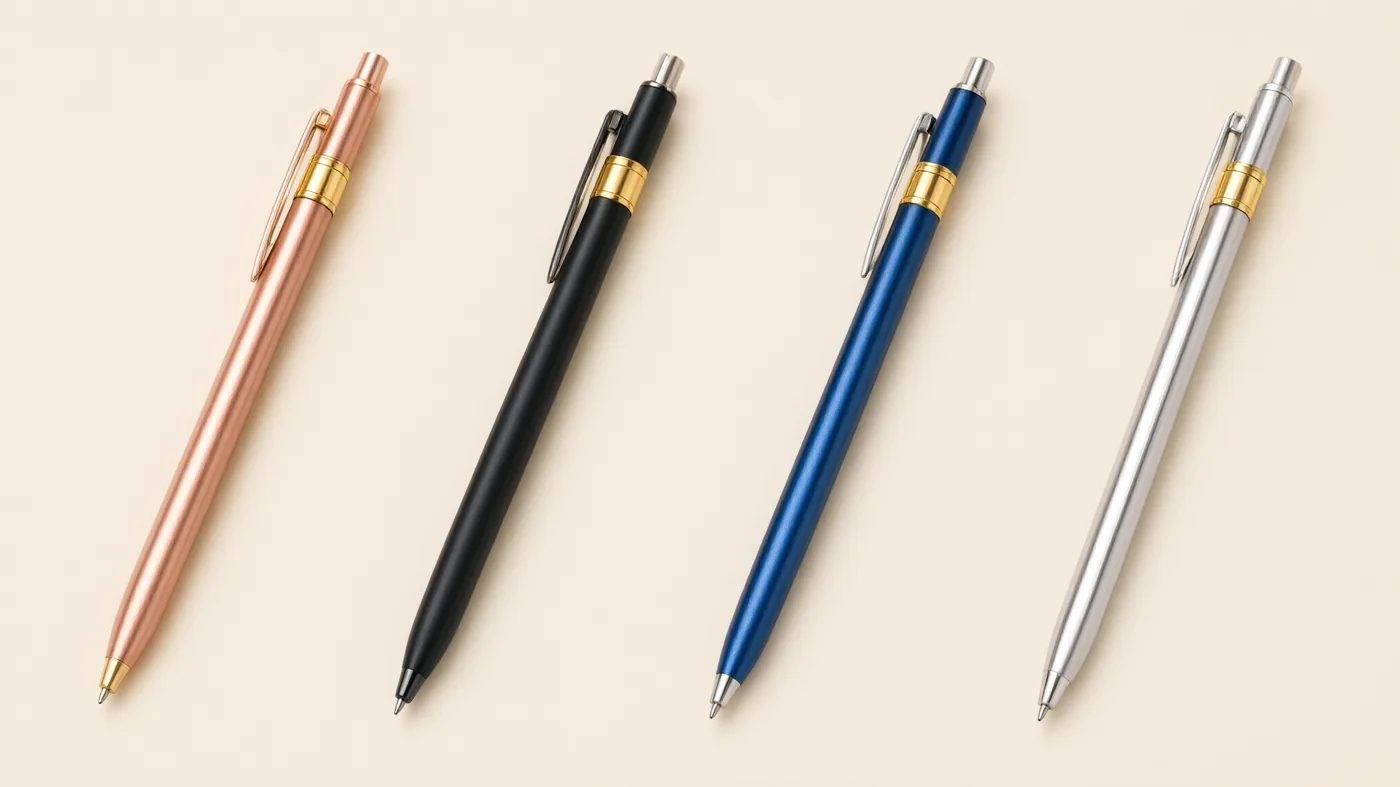
Aviation aluminum, sliding ring control, and it takes any brand of 2mm refill — HB, 2B, 4B, colored. Ships with 12 2B leads. 4.2★ from 3,145 Amazon ratings.
Common questions
Is a 2B pencil the same as a #2 pencil?
Close, not identical. The school No. 2 maps to roughly a B-grade core, and 2B is one step softer and darker. Scanners read graphite density, so a 2B fills a bubble sheet perfectly — it just smudges a little more than a true B. A box of 2B is a fine exam buy, and a No. 2 is a fine sketching pencil if you don't mind drawing a notch lighter.
What's the best pencil grade for sketching?
One pencil: 2B. Dark enough to look finished, controlled enough to erase and rework — it covers most beginners and plenty of working drafters. Three pencils: 2H for layout, 2B for tone, 4B for darks. That ladder gets you from faint construction line to full shadow. Charcoal-hungry drawers live at 6B and up; architectural sketchers camp on the H side.
Why does my 2B lead break more often than HB?
Softness is the point — less clay means a darker mark and a more friable rod. What breaks it is leverage, not recipe: too much lead past the sleeve, or a point worn back to a thin spike that snaps at the first cross-hatch. In a 2.0mm holder, keep the exposed stub near 2mm, re-cone it often, and 2B is plenty tough. The full checklist is in our lead breakage guide.