Fidget Pen for Adults: Why Busy Hands Help Focus at Work
Every long meeting has one. Around minute nine, someone starts rolling a ballpoint across their thumb — flick, full rotation, catch — while still taking notes, still answering questions, still visibly present. From outside, it reads as tuning out. From the inside, most pen-spinners will tell you it's the opposite: the hands get busy so the head can stay.
Fidget tools that help focus are usually sold as toys, which is exactly the problem. A foam cube doesn't survive a boardroom, a spinner whines into a hot mic, and neither one produces anything by the end of the day. Here's what actually matters for desk fidgets for work — silence, subtlety, plausible deniability — and why a fidget pen for adults beats a dedicated gadget: the fidget and the output turn out to be the same object.
Hands busy, brain engaged
The observation is older than the research programs studying it: people often think better when something occupies their hands. Students chew pencils, drivers twist keys, and self-described fidgeters describe the same bargain in plain language — a little motion absorbs the itch so the rest of the attention can keep listening. That's why "sit still and pay attention" has always been a strange instruction. For many people, a low hum of movement is precisely what makes sitting still possible.
One honest caveat before we go on: this is common experience, not medical advice, and nothing here diagnoses or treats anything. If focus problems are genuinely derailing your work or school, talk to a professional. This guide is about a smaller, practical question — choosing desk fidgets that help focus without announcing themselves to the whole floor.
The silence rule: office-safe or office-exiled
Filter number one is sound, and it quietly disqualifies most of the category. Clicky mechanisms are mechanical-keyboard energy — hugely satisfying to you, soul-destroying to everyone on the call. Foam toys are silent until they squeak. Spinners run near-silent until the bearing hum finds the conference-room microphone at the exact moment you're agreeing to your own budget cut.
What survives the filter is weight and motion instead of noise: rolling, sliding, spinning or squeezing something with heft, where the sensation comes from friction and mass rather than a click. A cool metal barrel under two restless fingers does more for a fidgeter than a warm squishy cube ever will — and it does it in total silence.
Three desk fidgets, honestly compared
These are the three things people actually buy, judged as tools for a working adult rather than as shelf toys:
| Squishy toy | Finger spinner | Tool-first fidget pen | |
|---|---|---|---|
| Noise | Silent until it squeaks | Bearing hum under a mic | Truly silent |
| Hand required | One, constantly | One, full grip | Two fingers, mid-air |
| Reads as, in a meeting | A toy | A toy | A pen |
| Produces anything? | No | No | Notes, sketches, signatures |
| Survival in the drawer | Weeks | Weeks | You'd carry a pen anyway |
The winner isn't close, and it comes down to one axis the other two don't even have. A squishy toy and a spinner each demand a whole hand and produce nothing at all — which is why both end up in a drawer by week three. A fidget pen wins because the fidget and the output are the same motion: the roll that keeps your fingers busy is the roll you were already doing holding any pen, and the object you're spinning writes. Nothing to hide, nothing to put down, nothing to explain when a colleague asks to borrow it.
The magnetic ring: a fidget built into a drafting instrument
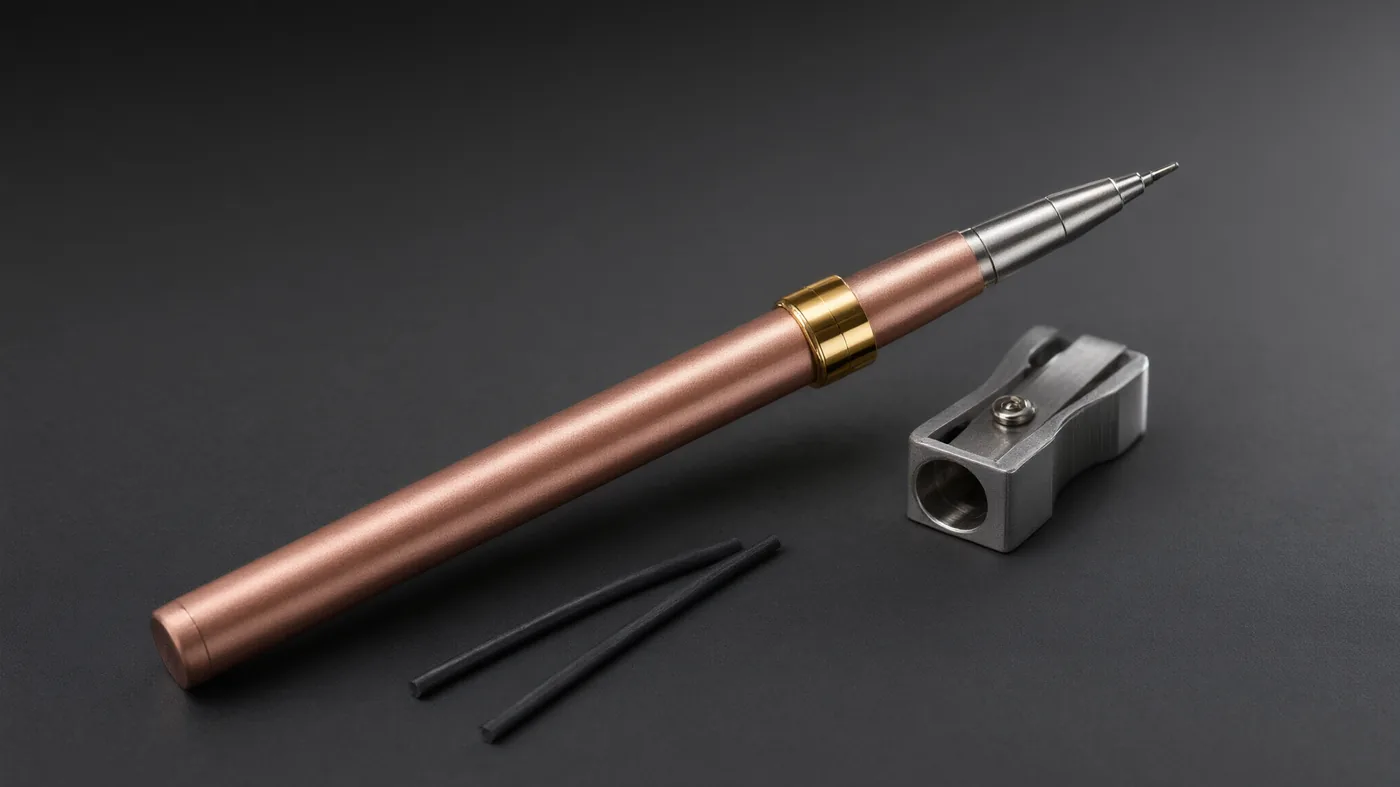
This site exists because of one specific version of that idea: the WSD magnetic lead holder. A small metal ring rides on rails along its barrel. Slide it up and down — that's how the lead advances and retracts, and it's also the fidget. Spin it around the barrel. Or lift it free and let it glide and hover along the rails, which is the trick that eats an entire earnings call. Two spare metal rings ship with it, so you can swap finishes when you're ready for a new one.
Worth saying clearly, though: it's first a professional 2.0mm drafting lead holder — 17.2 grams of aviation aluminum, balanced like an instrument, not like a gadget. (Here's why a 2mm holder beats a fine mechanical, and here's how to keep thick leads from breaking if you're new to them.) The fidgeting is what the ring does between tasks; the tool is what it does during them. At 4.2 stars across 3,145 Amazon ratings, buyers keep mentioning which half they ended up using more.
Meeting etiquette for the visibly fidgety
Even a silent, pen-shaped fidget still moves in a room full of people. Five rules that keep it invisible:
- Stay below the camera line on video calls. A ring rotation reads as calm; a wrist acrobatics routine reads as a distraction.
- Never add a click. If your fidget has a clicker, it has already lost its open-office appeal.
- Match motion to the moment. Slow rolls while listening, stillness while someone is asking you a direct question.
- If three people ask what it is, you're performing. Fidgeting that grabs attention has failed at its actual job.
- The golden rule: when a colleague says "got a pen?" — the answer should still be yes.
FAQ
Do fidget pens actually help with focus?
No product can promise that, and this isn't medical advice. What many self-described fidgeters report is the pattern this whole category bets on: quiet, weighted hand motion makes it easier to stay planted through long meetings. If your hands already spin whatever pen is nearest, you've seen the effect yourself — the trick is simply giving the habit an object that's silent, satisfying, and useful.
What's the best desk fidget for an open office or video calls?
The quiet ones that don't need a whole hand. In practice that rules out clickers and most spinners, and leaves low-friction motion: rings, sliders, weighted barrels. A fidget pen for adults clears every test at once, because it's silent by construction — a ring gliding on rails has no spring, no bearing, no squeak — and it already sits on your desk as office equipment.
Is a magnetic-ring pencil a gimmick?
Fair question. The ring is a real, useful mechanism — it advances and retracts the 2mm lead — that happens to be fun. Underneath it is an ordinary drafting lead holder in aviation aluminum, the same tool architecture architects have used for a century. Set the fidget aside entirely and you're still holding a serious 2.0mm pencil. Buy the tool; keep the toy as the bonus.
Slides, spins and hovers — and writes like a drafting instrument. Aviation aluminum, two spare rings, 4.2★ from 3,145 Amazon ratings.